Global Risks Report 2025 – The younger people are, the greater their fear of economic downturn

Published
10/2025 by Team buildData
This year (2025), we are a little late with our brief analysis of the World Economic Forum’s Global Risks Report 2025. It contains some interesting detailed changes to the global community’s assessments compared to previous editions, although in the 10-year outlook, the top rankings remain more or less unchanged in terms of topics.
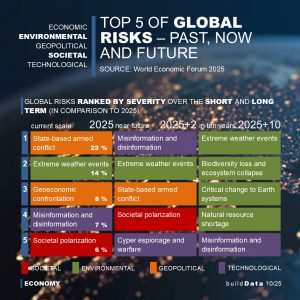
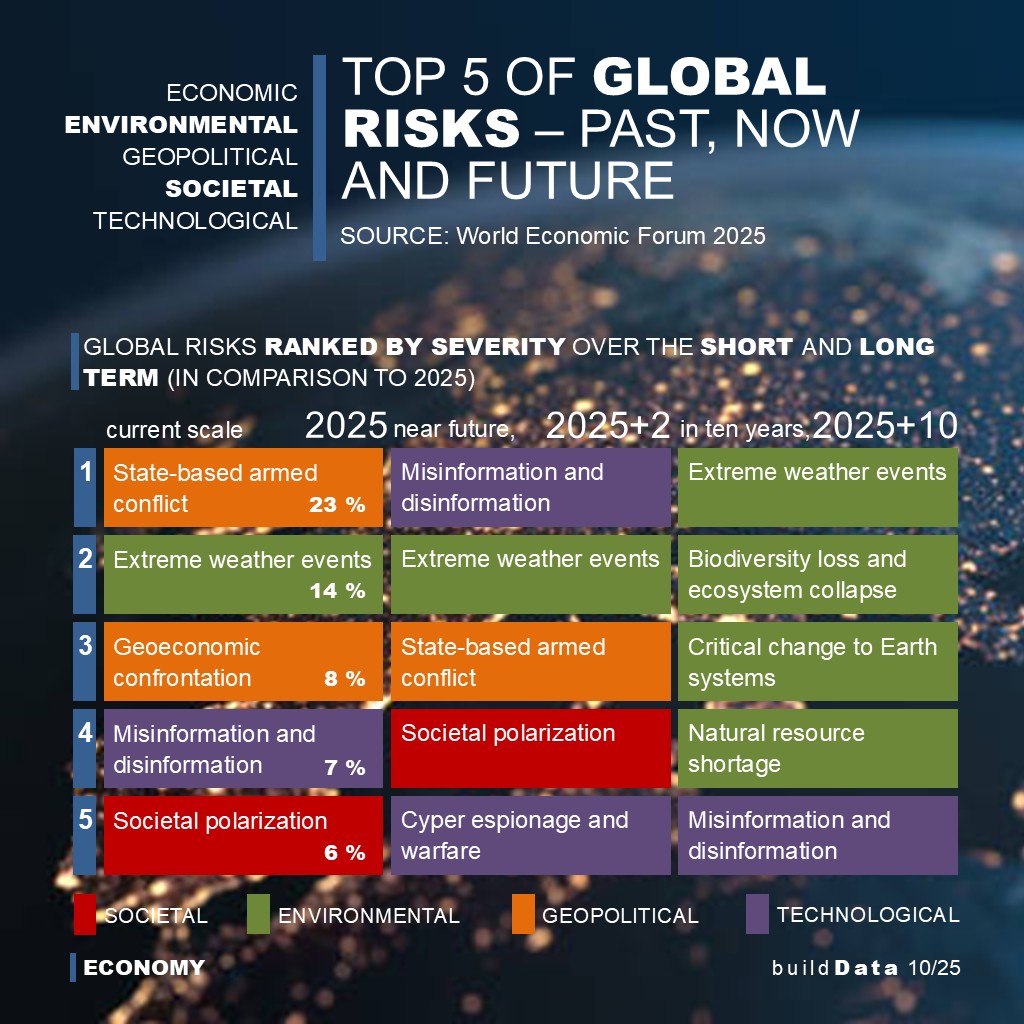
In its current outlook for the next 10 years, the global community assesses the risks associated with climate change as high. This assessment has been a continuous trend for more than 10 years. The risk of failing to meet climate targets is consistently ranked among the top 5 global risks.
In the current and forward-looking rankings for 2 to 10 years, this is reflected in the increasing fear of extreme weather disasters and the resulting environmental and economic consequences. In the outlook for 2025 +10 years, the top four positions are consistently occupied by environmentally relevant topics. As mentioned, the topic ‘Extreme weather events’ ranks first, followed by ‘Biodiversity loss and ecosystem collapse’, ‘Critical change to Earth systems’ and ‘Natural resource shortage’.
As the future draws nearer, however, the rankings show that the global community is being overtaken by current issues and environmental issues are temporarily losing focus. Examples include the global pandemic in 2021 and the current wars in Ukraine and Palestine and their consequences (inflation, energy supply, food).
While the fear of ‘extreme weather events’ is already ranked as the second-biggest risk by the global community, people are currently more focused on issues such as armed conflicts between states, global economic conflict, cyber espionage and cyber warfare, misinformation and disinformation, and increasing social polarisation. This is clearly a reflection of the current geopolitical tensions and the mutual hybrid military and non-military attacks.
The current Global Risks Report 2025 provides an interesting breakdown by age group. It highlights in particular that the younger generation ranks the risk of economic downturn and the associated risk of personal economic decline among the top three risks. In summary, it can be concluded that the younger people are, the greater their fear of economic downturn.
For people under the age of 50, this also applies to the topic of ‘lack of economic opportunities’. The under-30s are the only group to vote for the risk of decline in health and well-being.
Globally, the risk of economic downturn ranks among the top risks in the following regions: Latin America, North America, Oceania, South-Eastern Asia and Southern Asia. But even in the USA, the UK and emerging economies such as Brazil, respondents consider economic downturn to be one of the greatest risks.
The World Economic Forum's Global Risks Report is based on the Global Risks Perception Survey (GRPS), which was conducted in autumn 2024. The global risk landscape is compiled by over 900 experts from academia, business, government, international organisations and civil society. A global risk is defined as the possibility of an event or situation occurring that, if it did occur, would have a significant negative impact on a substantial portion of global gross domestic product, population or natural resources. The Global Risks Report 2025 is now in its 20th edition.