Volume of redispatch measures FOR RE fell by eleven percent

Published
10/2025 by Team buildData
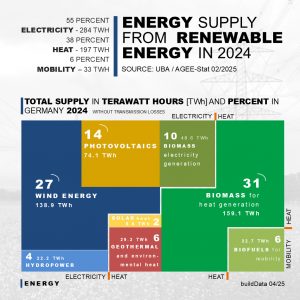
The continuous expansion of renewable energies is progressing faster than the expansion of the electricity grid, which poses major challenges for the overall system. In order to avoid grid overloads and thus ensure grid stability, targeted grid congestion management must be implemented. Read this article to find out how this works and what it costs.
The flow of electricity in Germany is characterised by a strong north-south divide. While numerous offshore and onshore wind turbines generate large amounts of electricity in the north, the majority of production facilities with intensive electricity requirements are located in southern Germany. Because grid expansion takes significantly longer to implement than the construction of new wind and solar power plants, the transmission and distribution grids are becoming bottlenecks. Grid capacities are significantly exceeded during periods of light winds.
This is when so-called grid congestion management comes into play, whereby the feed-in from plants upstream of a bottleneck is reduced and the feed-in from plants downstream of the bottleneck is increased. The aim is to optimise the grid load and ensure a continuous supply.
These measures cost money, which prompts some critics to call for a slowdown in the expansion of renewable energies and to counteract their volatility with conventional power plants in the grid.
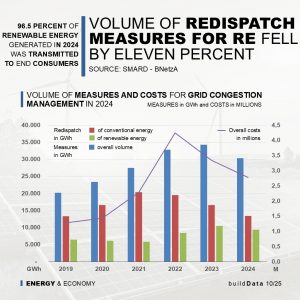
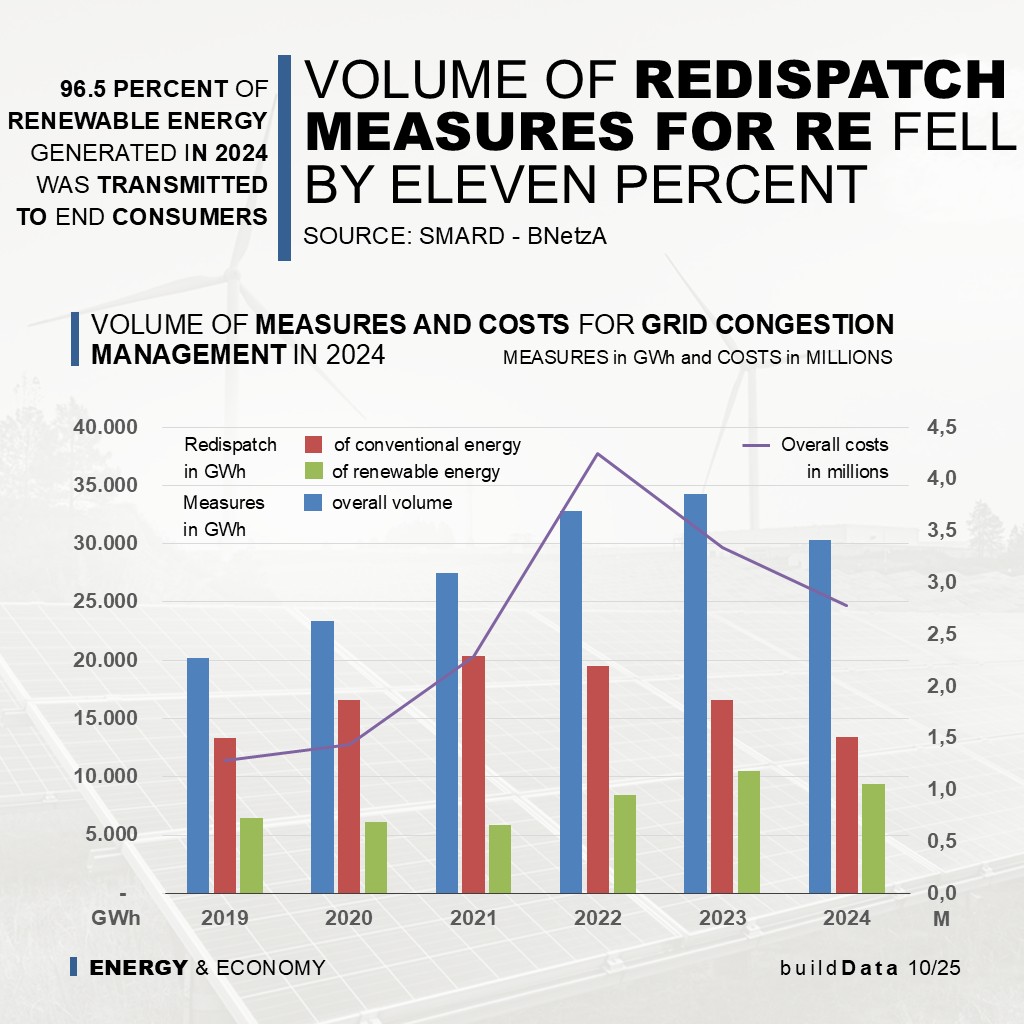
Compared to the previous year 2023, the volume of measures and the costs for grid congestion management fell by 12 percent (in GWh) and 17 percent to a total of €2,776 million, respectively. In the fourth quarter of 2024, however, they were significantly higher than in 2023, which is attributable to an increase in redispatch measures with offshore wind turbines (Q4 2023: 1,504 GWh; Q4 2024: 1,812 GWh) and the significant increase in redispatch measures with reserve power plants. One of the reasons for this was a prolonged wind front in December 2024, which led to bottlenecks. In the fourth quarter of 2024, the costs for redispatch measures totalled €928 million, around €44 million higher than in the same period of the previous year.
What are dispatch, redispatch and redispatch 2.0?
The term dispatch refers to the deployment planning of power plants by the power plant operator. The German term for dispatch is ‘Kraftwerkseinsatzplanung’ (power plant deployment planning). The term redispatch, on the other hand, refers to the short-term change in power plant deployment at the behest of the transmission system operators to avoid grid bottlenecks. In other words, when an impending overload of a line section is detected, the grid operators request power plant operators to increase or decrease the feed-in in order to eliminate the grid bottleneck. In October 2021, Redispatch 2.0 came into force in Germany, which also included generation plants and storage facilities from 100 kW and distribution network operators in the redispatch regime.
The renewable energy plants most frequently curtailed in Germany in 2024 were offshore and onshore wind turbines, with a total of 7,946 GWh. Compared to the previous year, curtailment of wind turbines fell by 20 and 15 percent (onshore and offshore, respectively). Solar plants were curtailed by a volume of 1,389 GWh, primarily in southern Germany. This corresponds to around 97 percent more curtailment of solar plants than in the previous year. The reasons for this are the enormous expansion of installed capacity within a year and the exceptionally high solar radiation in the summer of 2024.
Reserve power plants were used to relieve grid bottlenecks with 1,788 GWh. In comparison, the figure for the previous year 2023 was 1,214 GWh, and in 2022 a total of 2,934 GWh.
Despite the bottleneck problem, a total of 96.5 percent of renewable energies were fed into the grid and supplied to end consumers in 2024. In 2024, bottlenecks increasingly shifted to the transmission grids (74 percent), although 47 percent of the curtailed renewable energy power plants are located in the distribution grid.
What is countertrading?
While redispatch is a direct, grid-based measure, countertrading is an indirect, market-based measure to avoid electricity grid bottlenecks. Countertrading influences the load flow through the short-term purchase or sale of electricity by grid operators on the intraday market.
In 2024, the volume of countertrading measures amounted to around 5,739 GWh, a decrease of 5 percent compared to 2023, which is attributable to additional grid expansion.
Operators of renewable energy power plants receive financial compensation for curtailment, which amounted to around £554 million in 2024. In 2023, the figure was around £580 million. This represents a decline of just over 4 percent, while the decline in volume was around 10 percent. The reason for this is the fall in wholesale prices, which means that operators of renewable energy plants are simply missing out on subsidies under the Renewable Energy Sources Act.