EXIT FROM BREXIT? UK CONSTRUCTION SAYS 52% YES

Published
10/2026 by Team buildData
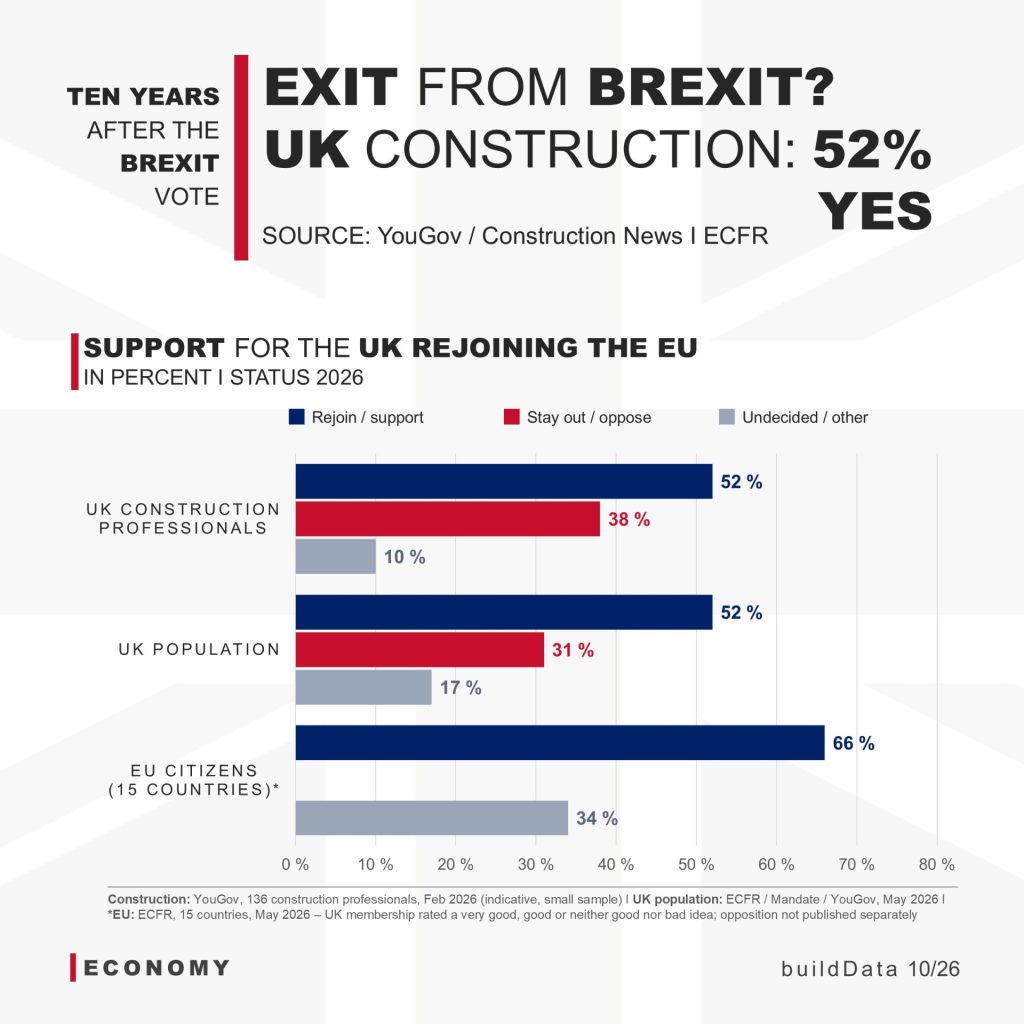
Ten years after the referendum, a majority of British construction professionals would vote to rejoin the European Union. Across the Channel, the door appears to be open.
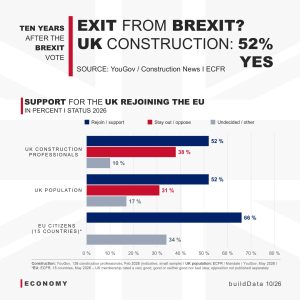
In June 2016, the UK voted by 52 to 48 per cent to leave the EU. A decade later, the same number has reappeared with the opposite meaning. According to a YouGov survey published by Construction News for the tenth anniversary of the vote, 52 per cent of UK construction professionals would now vote to rejoin the EU. Only 38 per cent would stay out. For an industry that depends on imported materials, mobile labour and long-term planning certainty, this is more than a mood swing. It is a judgement on ten years of practical experience.
Construction, the public and Europe compared
The survey found that 59 per cent of construction respondents consider leaving the EU the wrong decision, and only 33 per cent the right one. Among the general public, 57 per cent say Brexit was wrong and 31 per cent right.
A separate study by the European Council on Foreign Relations (ECFR), carried out with YouGov and Mandate Research in May 2026, adds the European perspective. In the UK, 52 per cent would vote to rejoin, 31 per cent would stay out and 11 per cent are undecided. In 15 European countries, 66 per cent consider UK membership a very good, good or at least not a bad idea. Support ranges from 56 per cent in Bulgaria to 75 per cent in the Netherlands and Denmark.
One caveat: the construction figures are based on 136 respondents, taken from a wider YouGov sample of more than 6,000 people. Managers are likely overrepresented. The result is a strong indication, not a representative census of the workforce.
Why construction feels Brexit on site
Construction is a domestic industry, but its supply chains are not. Materials, components and specialist labour have long crossed the Channel. Jun Du, professor of economics at Aston Business School, notes that around two-thirds of construction firms report longer delivery times that they attribute to Brexit.
The workforce has shrunk as well. UK construction employment peaked at 2.42 million workers in the first quarter of 2019 and fell to 2.05 million by the end of 2025.
Trade has suffered too. Goods trade between Germany and the UK fell by 7 per cent between 2015 and 2025, to €118.4 billion, according to KPMG and the British Chamber of Commerce in Germany.
Not everything is Brexit
The picture is more complex than a simple before and after. An analyst quoted by Construction News argues that most of the skilled workers lost since 2019 did not leave because of Brexit. They retired: the decline is concentrated among UK-born workers aged 50 to 64. On construction costs, the same analysis sees more recent global shocks as the stronger driver. In 2026 alone, the Iran war has more than doubled European gas prices since January.
Critics of a closer relationship also make a structural point. In their view, time spent negotiating with Brussels is time not spent fixing domestic problems such as restrictive planning rules. And politically, the issue is less settled than the polls suggest: Reform UK, the party that grew out of the Brexit movement, led Westminster voting-intention polls in June 2026.
From mood to policy?
What was a taboo for years is back on the agenda. At the end of September, Prime Minister Andy Burnham said the UK would weigh its options: the status quo, a customs union, the single market – or going “all the way” and rejoining. At the same time, he said the time is not yet right to re-run the referendum.
Each step has a price. A customs union would remove tariffs on goods but undo only part of the trade losses. Single-market membership would require free movement of people, the jurisdiction of the European Court of Justice and dynamic alignment with EU rules. The next opportunity is the EU-UK summit in Brussels, planned for 20 November.
For the construction industry, the practical questions matter more than the symbolic one. Mutual recognition of product standards, simpler customs procedures and easier mobility for skilled workers would ease many of the problems sites face today. The survey sends a clear message: those who build Britain are ready for a closer relationship with Europe. Whether politics follows is the question for the next decade.