From cable pooling to auction pooling: the missing link for BESS in Poland

Published
10/2026 by Thomas Hartwig
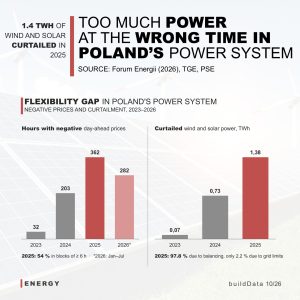
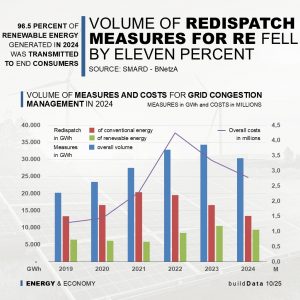
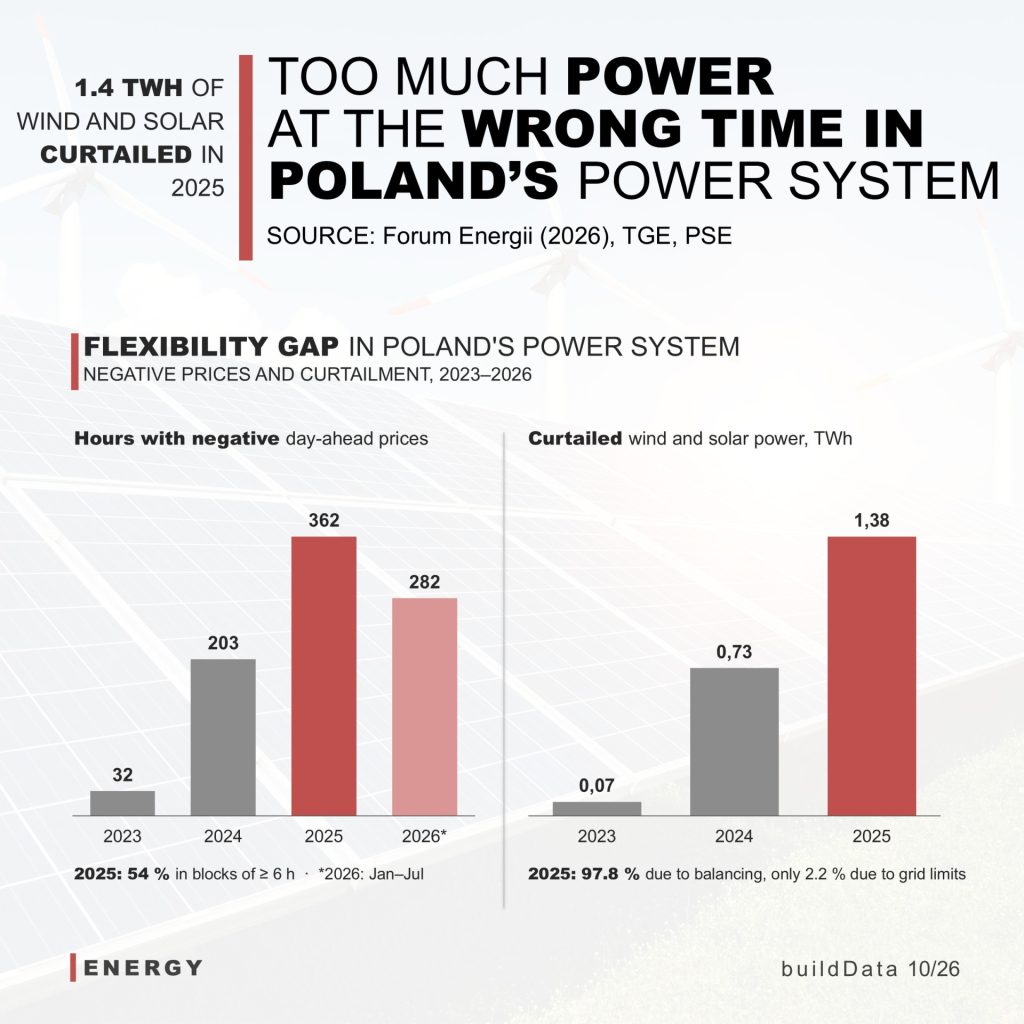
Poland’s renewable boom has hit a wall that is not made of copper. In 2025, almost 1.4 TWh of wind and solar power could not be fed into the grid – twice as much as a year before. According to a new report by the Warsaw think tank Forum Energii, 97.8 percent of it was lost for balancing reasons: too much power at the wrong time, and nowhere to put it.
The missing piece is battery storage (BESS) – and Poland’s auction system does not pay for it.
From 32 to 362 hours of negative prices
Negative prices on the Polish day-ahead market first appeared in 2023, for 32 hours. In 2024 there were 203 hours, in 2025 already 362. From January to July 2026 alone the counter stood at 282 hours – with deeper dips below zero. More than half of these hours now come in blocks of six hours or longer: 104 of 203 hours in 2024, 195 of 362 in 2025.
Forum Energii is clear about the cause. The problem is not "too much renewables", but too little flexibility – on the supply side (no storage next to wind and solar parks, inflexible coal units) and on the demand side (few dynamic tariffs, few batteries). Solar is hit hardest: around 10 percent of potential PV output is curtailed, compared with about 1 percent for wind.
An auction system with a blind spot
Since 2016, Poland's renewable energy auctions have delivered 4.2 GW of solar and 3.3 GW of onshore wind at very low cost: the RES surcharge was zero in several years and is 7.3 PLN/MWh today. But the system was built to produce as many megawatt-hours as cheaply as possible – and to leave balancing to others.
Three design features keep batteries out:
- Settlement against the daily average price (TGeBase). A plant earns the same whether it delivers at noon or at 8 pm, so shifting energy with a battery does not pay off.
- Hybrid auctions exist only on paper. The RES Act foresees them, but state aid was never approved, and the required 60 percent capacity factor practically excludes PV and wind.
- Cable pooling stops at the auction door. Since April 2026, batteries may share a grid connection with wind and solar parks. But only one installation per shared connection may receive auction support – a rule the draft RES Act amendment UC118 is meant to remove.
Investors who still want storage have to stack other instruments such as the capacity market or grants. This fragmentation raises risk and cost and pushes up auction bids.
New grid rules: batteries are already on board
The grid side has moved faster than the auction side. An amendment to the Polish Energy Law (UC84) has been in force since 30 April 2026. It extends cable pooling to energy storage: one or more batteries may now be connected at the same point as a PV or wind park, under one set of connection conditions and one agreement. Adding a battery without raising the connection capacity requires no advance payment, and the grid study no longer includes a load-flow analysis.
The amendment also introduces two new connection contracts that make batteries almost a must. A flexible connection agreement allows the grid operator to cap feed-in until the grid is reinforced, for up to three years. A configurable agreement can impose such caps permanently, varying by season or time of day. In a typical example, a 30 MW solar park may feed in only 12 MW between 11 am and 1 pm in summer. Without storage, that midday energy is lost; with storage, it is sold in the evening.
At the same time, the rules get stricter for every project. Grid connection agreements now expire automatically if milestones are missed: battery projects need a final building permit for 80 percent of their power and capacity within 24 months. Applicants pay an application fee of 1 PLN/kW, an advance payment of 60 PLN/kW and a security of 30 to 60 PLN/kW.
What Forum Energii proposes
The EU approval for the Polish auction scheme expires at the end of 2027. Without a decision in 2026, the authors warn of an investment gap of up to 18 months. For storage, they recommend:
- Separate reference prices for PV and onshore wind with storage, linked to a minimum battery size – for example at least 25 percent of plant capacity and two hours of storage.
- Settlement against monthly or quarterly indices instead of TGeBase. In the report's example, a plant earns 229 PLN/MWh under daily settlement, but more than 500 PLN/MWh if it stores midday power and sells in the evening peak.
- Non-price criteria under the EU Net-Zero Industry Act, with 10 percent weight for system integration: points for a higher storage-to-capacity ratio, for becoming a balancing service provider within 12 months, and for grid-forming inverters.
The industrial paradox
The report's most surprising figure has nothing to do with the grid. Polish exports of energy storage systems grew from 3.0 to 7.4 billion euros between 2019 and 2024. In 2024, Poland was the world's third-largest exporter of energy storage – from battery separators and housings to complete lithium-ion systems. Forum Energii therefore suggests rewarding local content for batteries in future auctions as well.
Germany shows how it works
German innovation tenders for solar-plus-storage show what a dedicated auction can do. In October 2025, 490 MW were awarded, the round was four times oversubscribed, and every winning bid was a PV-plus-storage project. Average award prices fell from 306.7 PLN/MWh (October 2024) to 229.7 PLN/MWh (October 2025), as converted by Forum Energii.
Conclusion
Poland's next renewable growth phase – the national energy and climate plan targets 43 GW of solar and 28.8 GW of onshore wind by 2040, up from 27 GW and 11 GW today – will not be decided by panels and turbines alone. It will be decided by whether the next auction design pays for flexibility. For engineers, developers and EPC contractors, a change is coming: hybrid PV-plus-BESS projects with grid-forming inverters are set to become the standard, not the exception
Finally, we would like to recommend that anyone interested in the Polish energy transition take a look at the report by Forum Energii. Please use the link below.