Every fourth euro can be saved: How flexibility makes distribution grid expansion more affordable

Published
11/2026 by Team buildData
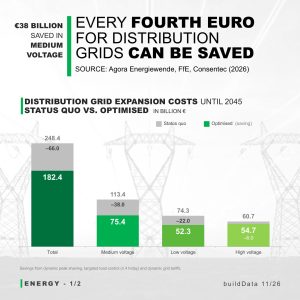
By 2045, Germany’s distribution grids will require around €248 billion in expansion – if nothing changes. A new study by Agora Energiewende, FfE and Consentec shows that smarter planning and grid operation can cut this to €182 billion. The biggest levers are not copper, but control.

The distribution grid becomes the bottleneck of the energy transition
Whether Germany's energy transition can be delivered affordably is increasingly decided in the distribution grid. This is where millions of photovoltaic systems, wind farms, heat pumps, charging points and battery storage systems are connected. For the study “Cost-efficient expansion of the distribution grid”, the Research Center for Energy Economics (FfE) and the consultancy Consentec modelled the German distribution grid using representative low-, medium- and high-voltage networks and compared ten innovative measures with conventional expansion.
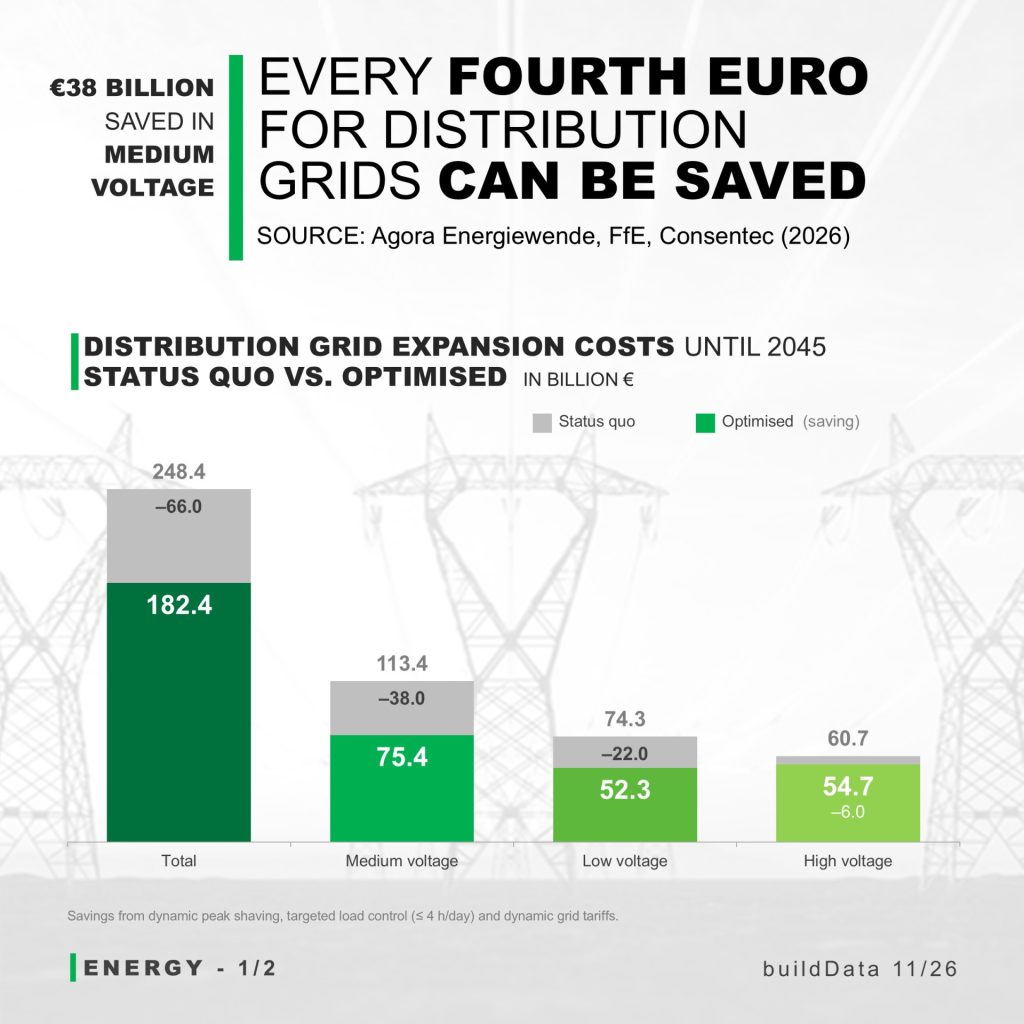
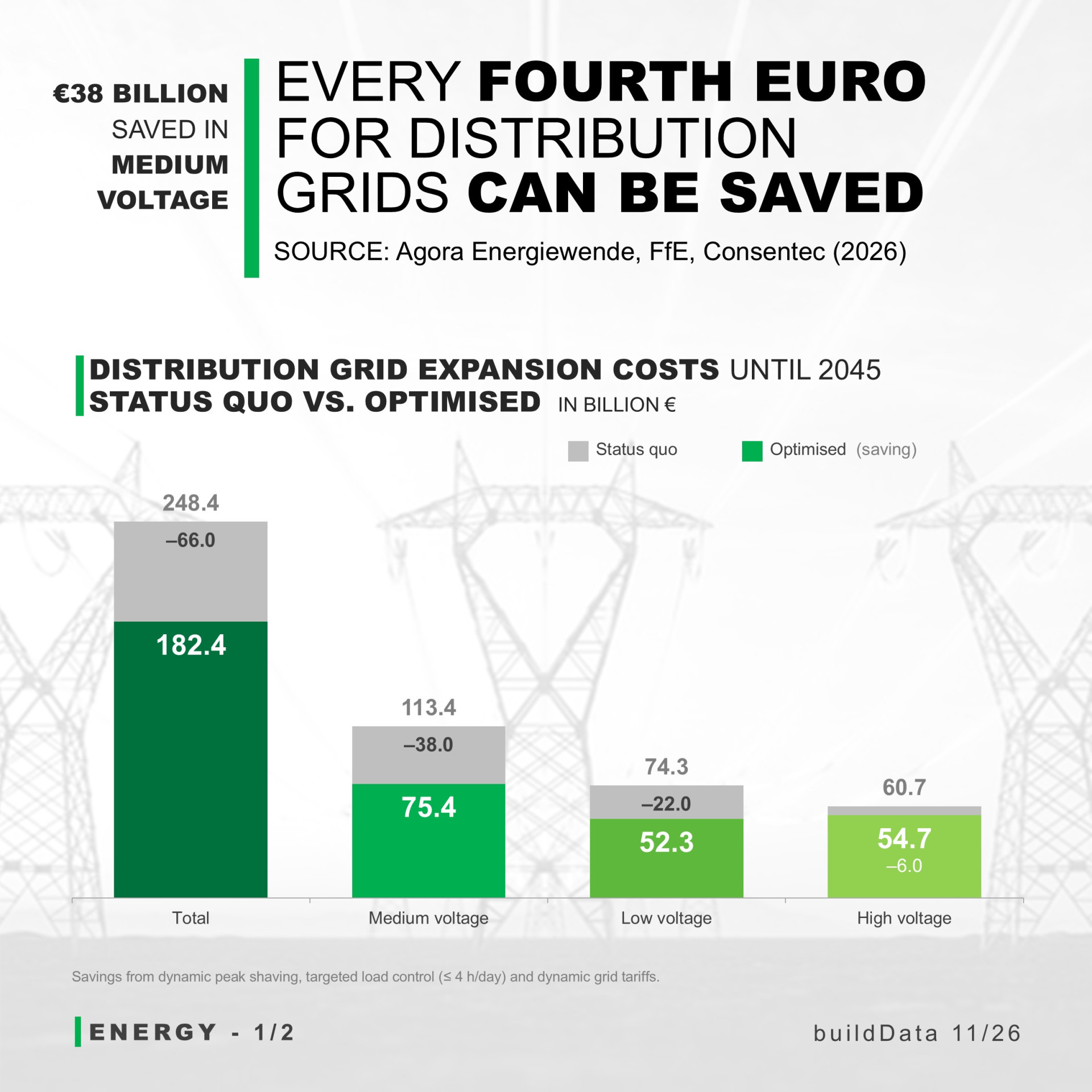
The result: if planning continues as before – with every grid designed for the highest conceivable load peak – grid-dimensioning investments of around €248 billion will be needed by 2045. Combining expansion with innovative measures reduces this to €182 billion. That is €66 billion or 27 percent less. The authors explicitly describe this figure as a conservative lower bound, as only clearly attributable effects were taken into account.
What drives the costs
Without countermeasures, annual expansion volumes rise from €7.0 billion in 2030 to €16.1 billion in 2045 – a factor of 2.3. At the same time, the cause shifts: until the mid-2030s, expansion is driven mainly by feed-in peaks from solar and wind plants. After that, load takes over – the electricity demand of heat pumps, electric cars, electric trucks and new industrial processes. Around two thirds of expansion costs therefore arise only after 2035, and expansion needs increasingly extend to suburban and urban grids as well. Without countermeasures, around three quarters of local low-voltage grids would be overloaded by 2045.
The decisive factor is that growing loads and feed-in coincide in the same, often short time windows. To date, the entire grid is dimensioned for these rare peaks.
Medium voltage as the largest cost block
The first chart compares the status quo with the optimised scenario by voltage level. The grey bars show expansion costs under conventional planning, the green bars the costs with innovative measures. The visible grey area represents the saving in each case.
Medium voltage, including the transformation level to high voltage, stands out. At €113.4 billion, it accounts for 46 percent of expansion costs, making it the largest cost block. At the same time, it offers the greatest savings potential: costs fall to €75.4 billion, a reduction of €38 billion. In low voltage, requirements fall from €74.3 to €52.3 billion, in high voltage from €60.7 to €54.7 billion. High voltage benefits least because it aggregates the load and feed-in profiles of many grid areas, where local control has little effect.
Three levers, unevenly distributed
The second chart shows which measures generate the savings. The bars carry the colour of their voltage level; the narrow strip below shows the split across the three levers.
The first and largest lever is targeted load control, contributing €40 billion. Under Section 14a of the German Energy Industry Act (EnWG), grid operators may reduce heat pumps and charging stations to a guaranteed minimum power when an overload is imminent. The study goes beyond current regulation: today, a grid operator must expand the grid as soon as it foreseeably has to intervene on a permanent basis. In the model, by contrast, further grid expansion is only triggered when interventions of no more than four hours per day are no longer sufficient to resolve the congestion. The effect is split between low voltage at €19.5 billion and medium voltage at €20.5 billion, the latter relieved indirectly through lower aggregate loads. Even two hours of control per day reduce requirements by €16.8 billion.
The second lever is dynamic peak shaving, worth €22.5 billion. PV feed-in is curtailed only in those hours in which it would actually cause congestion – at most five percent of each plant's annual energy. The effect is concentrated in medium voltage at €17.5 billion, above all at the substations to high voltage.
The third lever is dynamic grid tariffs, worth €3.5 billion: locally and temporally differentiated price signals encourage large battery storage systems to shift their consumption away from congestion hours in high voltage. However, the study also shows the limits. Rigid time windows, as provided for in today's time-variable grid tariffs, do little to relieve the grid. If many consumers respond to the same signal at the same time, new load peaks can even arise at lower grid levels. Dynamic grid tariffs therefore need to be coordinated across grid levels.
Gaining time – but not postponing
In addition to these permanently effective measures, the study examines instruments that primarily buy time. With overbuilding, a wind or solar park receives a smaller grid connection than its peak output. This reduces feed-in-driven expansion in medium voltage by 59 percent by 2030. However, the effect diminishes as load grows. Battery storage at the generation site has a similar effect. The study refers to these as bridging measures: they relieve planning and construction capacities in the short term, but deferred does not mean avoided.
What is needed now
These potentials can only be realised if the grid becomes observable and controllable. Without metering, grid state estimation and digital grid operation, the measures remain theoretical. The authors therefore call for regulatory incentives that reward higher grid utilisation, adapted planning principles with a focus on load, and greater transparency and commitment in grid expansion planning. They are critical of the fact that current policy proposals are largely limited to blanket, generation-side solutions.
The message is relevant for the construction and real estate sector: heat pumps and charging infrastructure in buildings are not only drivers of grid expansion but also the most important part of the solution. Those who plan and connect them to be controllable help ensure that every fourth euro in the distribution grid can be saved.