Most EPC disputes are home-made – and predictable

Published
11/2026 by Team buildData
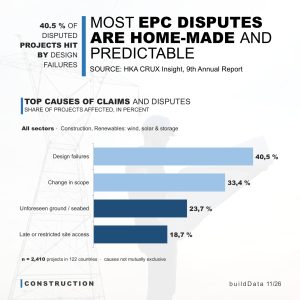
Design failures affect 40.5 % of all construction and engineering projects that end in claims or disputes, scope change 33.4 %. In renewables, unforeseen ground or seabed conditions and late site access add to the list. Drawing on 25 years of projects in the UK, Germany, Poland and worldwide, and on arbitration and court proceedings, Thomas Hartwig names seven shortfalls that turn wind, solar and storage projects into disputes – and explains why de-risking starts before signing.
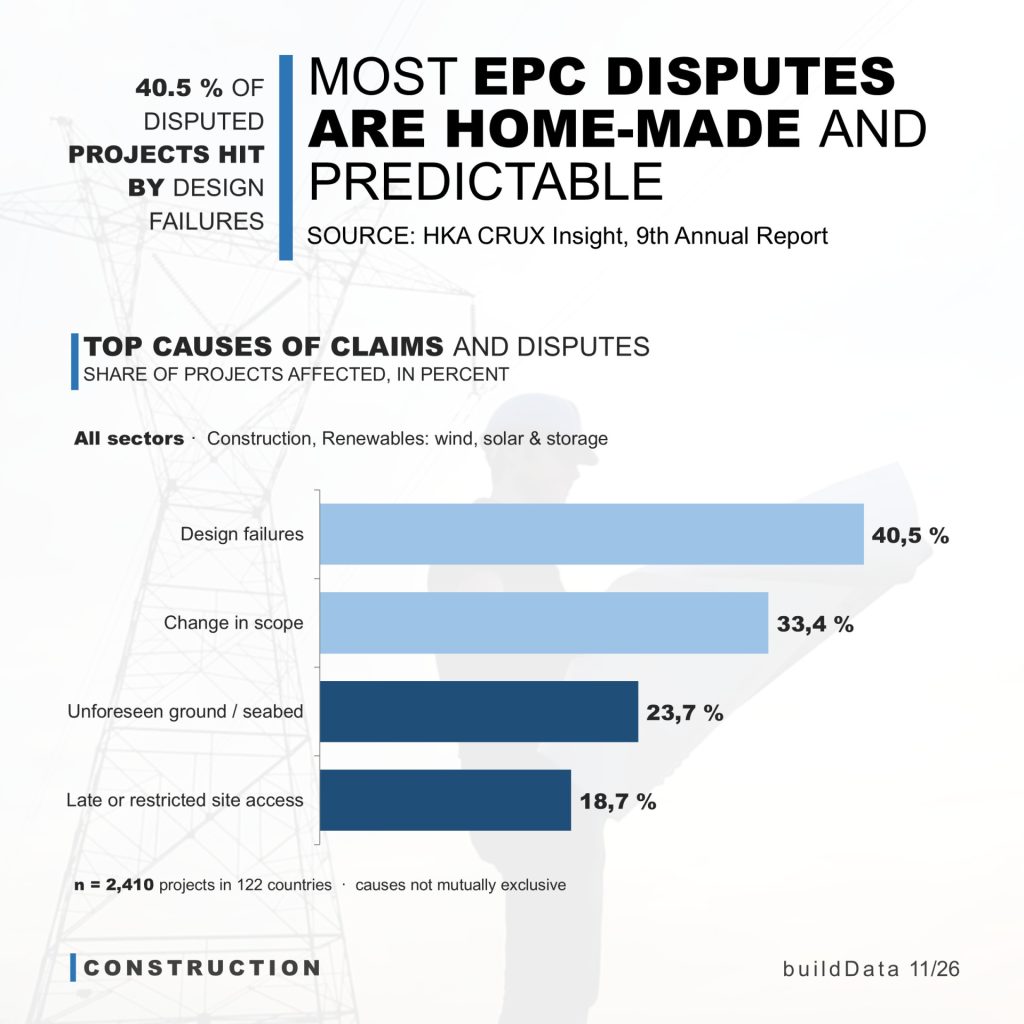
The numbers point to the beginning, not the end. HKA's CRUX Insight programme analyses 2,410 projects in 122 countries that ended in claims and disputes. Across all sectors, design-related failures are the most frequent cause, affecting 40.5 % of projects, followed by change in scope at 33.4 %. For renewable energy projects, two site-related causes stand out: unforeseen conditions, typically ground or seabed, disrupted 23.7 % of projects, and late or restricted access a further 18.7 %. Each is the result of decisions that were taken early – or not taken at all.
The errors surface later – on site and during commissioning. In offshore wind, contractor error and defects were the root cause of 63 % of construction insurance claims, according to the insurer GCube – a question of execution capability that is decided with the choice of partner. For battery energy storage systems, EPRI's analysis of failure incidents shows that 72 % occurred during construction, commissioning or the first two years of operation. Where a root cause could be assigned, integration, assembly and construction – not the battery cell – was the most common: components from different vendors that were not designed to work together. At its core, this is an interface issue that has to be settled in design and contract. What is at stake is shown by a 2020 HKA analysis: on disputed EPC projects across all sectors, an average of 47 % of the original contract value was claimed.
Shortfall 1: BoP, EPC and EPC-M are offered by many, but mastered by few. Few companies can deliver every building block from their own resources: engineering, procurement, construction, grid connection and permits, commissioning – and above all the "M", the management of interfaces. Whoever does not firmly command all of these blocks turns the interfaces into the risk, and the interfaces are exactly where claims begin. The simplest test for any bidder: who on this team has done it personally?
Shortfall 2: negotiating means solving conflicts, not making rotten compromises. Cooperation starts at the negotiating table, and that is where too much is often promised. Critical items are parked "for later" because signing should not be jeopardised by difficult discussions. But a postponed conflict is not a solved one – it only becomes more expensive.
Shortfall 3: technical conflicts are not sufficiently addressed. Grid code compliance, ground conditions, performance and availability guarantees: these issues belong before award, not in the annexes of the contract. The interfaces between trades are particularly critical – and so is the question of who owns them. Under an EPC contract, this risk lies with the EPC contractor. Where main components and balance of plant are contracted separately, it lies with the owner – and this is exactly where the "M" in EPC-M has to take effect. Every open technical point needs an owner and a date before award.
Shortfalls 4 and 5: the true partner shows after the key handover. EPC obligations do not end at commercial operation. Defect remediation is where commitments are tested – fast response, root-cause fixes and no finger-pointing between manufacturer and contractor. A partner can only be someone who brings continuity and reliability from start to finish: the same key people from the bid to the end of the warranty period, still at the table when it gets uncomfortable.
Shortfall 6: a dispute is the unfinished negotiation, continued. Once a project has gone wrong, the conflict moves out of court or into it. It is usually the continuation of negotiations that were cut short before award. In around 90 % of the disputes the author has worked on, the issues at stake were the ones not sufficiently addressed at the beginning – only now with lawyers, experts and considerable costs at the table. Here, too, negotiating means solving the conflict, not splitting the difference.
Shortfall 7: finish the negotiation – with no more than five voices. Negotiations should be led by four or five people: two per party and, if needed, a mediator. With more speakers, a negotiation turns into a conversation. A larger team advising in the background is not a problem; it is essential. One recommendation for that team: at least 30 % female advisers. This is not about quotas, nor about whether women are the better conflict solvers. It is about the diversity of arguments.
De-risking starts before signing. The construction phase itself carries considerable potential for errors, but the course is set earlier – in the choice of partner and at the negotiating table. Three principles sum it up: master every building block or do not offer it; resolve conflicts early instead of postponing them; and stay committed to the end, well beyond the key handover.
This article is based on a brief input by Thomas Hartwig at the German-Polish Energy Summit 2026.